CLAD COINAGE
By Pete Apple
The U.S Mint began producing clad coinage in 1965 in order to address the problem of a diminishing supply of silver which had been in use at the time for coinage. Silver supplies were projected to last another 3-5 years at the then current rate of coin manufacture. For the Dime and the Quarter beginning in 1965 and for the Half Dollar beginning in 1971 Cupro-Nickel was selected as the alloy for the clad layers (the same composition as existed for the Nickel). The alloy consisted of 75% +/- 2.5% Cu and 25% +/- 2.5% Ni. A silver alloy was selected for the Half Dollar from 1965-1970 consisting of 80% +/- 0.6% Ag and 20% +/- 0.6% Cu.
The desirability of clad coinage has been explained as follows:
“Among US circulating coins, only the one-cent coin is plated and only the 5-cent coin is monolithic. All other circulating coins are of roll clad construction. It has been generally accepted by United States Mint engineers and in the coinage literature that a clad coin has greater security than plated or monolithic coins; the clad layer is more consistent in EMS than a plated layer and the allowable acceptance values (for automated coin validation) can therefore be more tightly defined for a clad coin. In addition, it is difficult for counterfeiters to perform rollcladding because a large capital expense is required for a roll-cladding facility whereas an inexpensive plating system can be readily assembled. Furthermore, it is relatively easy to make the clad surface layers thick for a desired EMS because a given amount of surface wear represents a smaller percentage of a clad layer than that of a plated layer, normal coin wear does not impact the EMS of clad coins to the degree that it does plated coins. More consistent EMS responses and greater coin security are therefore found in clad coins during circulation. Clad coins are therefore used in high-denomination coinage. Plating has been used for the one cent coin because its face value is considered too low to provide sufficient incentive to counterfeit.” {EMS = Electromagnetic Signature} Page 3-4 Alternative Metals Study, op.cit.
The US Mint purchases materials for clad coin production from Olin Brass. Blanks are punched from a coin strip which has been through a bonding mill that binds clad strips around a core of pure copper (occasionally called a "Johnson Sandwich" after Lyndon B. Johnson, the US President at the time). The coin strip is then sent through a rolling mill which rolls the strip to the specified coin thickness.
The thickness of the copper core (prior to the punching of blanks and their subsequent upsetting) is:
Dime 688.34 µm (+/- 25.4 µm)
Quarter 916.94 µm (+/- 25.4 µm)
Half 1168.4 µm (+/- 50.8 µm)
The thicknesses of the elements of the composite strip out of which blanks are punched:
Dime clad layer (75% +/- 2.5% Cu and 25% +/- 2.5% Ni) = 180.34 µm (+/-25.4 µm)
Dime Copper Core (pure copper) = 688.34 µm (+/- 25.4 µm)
Quarter clad layer (75% +/- 2.5% Cu 25% +/- 2.5% Ni) = 231.14 µm (+/- 25.4 µm)
Quarter Copper Core (pure copper) = 916.94 µm (+/- 25.4 µm)
Half clad layer (1965-1970 (80% +/- 0.6% Ag and 20% +/- 0.6% Cu)
Thickness = .254 mm +/- 0.0254 mm (254µm) per side +/- .0508 mm (50.8 µm)
Half Copper Core (21.5 +/- 0.6% Ag and 78.5 +/- 0.6% Cu)
Thickness = 1.1684 mm (1168.4 µm) +/- 0.0508 mm (50.8 µm)
Thicknesses presumed to be the same for Half after 1970
Various errors involving missing layers in clad coins are possible.
Frequently coins with environmental damage from being in the ground or
other sources are mistaken for coins with missing clad layers. An
important factor for attributing missing clad layer coins is the weight of
the coin as well as the coin’s appearance. For example, the appearance of the clad surface is frequently mistaken for the
copper core when the copper content of the clad layer has oxidized to Cuprous
Oxide (Cu2O), which is a copper color.
Single Clad Layer Weights
Dime Clad layer weight = 0.41 g +/- 0.07 g
Quarter Clad layer weight = 0.96 g +/- 0.12 g
Silver Half (1965-1970) Clad layer weight 1.90 g +/- 0.39 g
Half (1971 – present) Clad layer weight = 1.67 g +/- 0.41 g
(Tolerance is a function of the combination of the tolerance for the ratios
of metals in the alloys and the tolerance for the thickness of the clad strip).
An extremely rare form of missing cladding is the loss of a clad layer prior to the
rolling of the strip to the specified coin thickness. This results in a coin of normal
weight.
Other errors include:
Missing Clad Layer Partial After Strike
Missing Both Clad Layers
Missing Full Clad Before Strike
Partial Clad Layer Before Strike
Laminations In Clad Coins (Quite unusual since the clad layer is already quite
thin).
Coreless Or All Clad Coins (no copper core)
Other Clad coins:
The Eisenhower dollar coins from 1971 to 1976, minted as proofs from San
Francisco were also clad planchets, but had a different composition. The inner
core was .791 copper to .209 silver alloy bonded to layers made from an alloy of
80% silver and 20% copper.
Susan B Anthony: 75% Cu, 25% Nickel sandwich over a Cu core.
Presidential, Sacagawea, Native American $1: Copper with manganese brass
cladding: 88.5% Cu, 6% Zn, 3.5% Mn, 2% Ni
The coin below was submitted by James Wright. This is a 2005 Oregon State Quarter that appears to be missing the obverse clad layer. This one weigs in at 4.5 grams. Normal weight should be 5.67 grams. So this one is shy by 1.17 grams. As you can see, the coin is also thinner than normal, which directly contributed to the lack of details that are evident on both sides of the coin. This was found by James while coin roll hunting.


Another one here, very similar to the one above appears to be missing the reverse clad layer. This coin was submitted by Andrew Ouellette, but is owned by Casey Smith. This one weighs in at 4.7 grams. Once again, notice the weakness in the details on the obverse.


Here is one that was submitted by Rorrie McCoy. He found it in his change. This one appears to have had a flaw in the copper core which may have led to the clad layer being partially missing prior to strike on the top left. Then either during or after the strike, the bottom larger portion came off. The weakness on the reverse at the 7:00 position lines up with the pre-strike missing piece at 11:00 on the obverse. Weight is 5.2 grams. Read more about this specific coin in an article written by Ken Potter here. https://www.numismaticnews.net/article/missing-top-layer-makes-quarter-rare?fbclid=IwAR1iz9bqTHP4jiBAR-U9SzENdX4Z_SYR6elhXlqDF1pSe--aLcSPDZ6kVE0


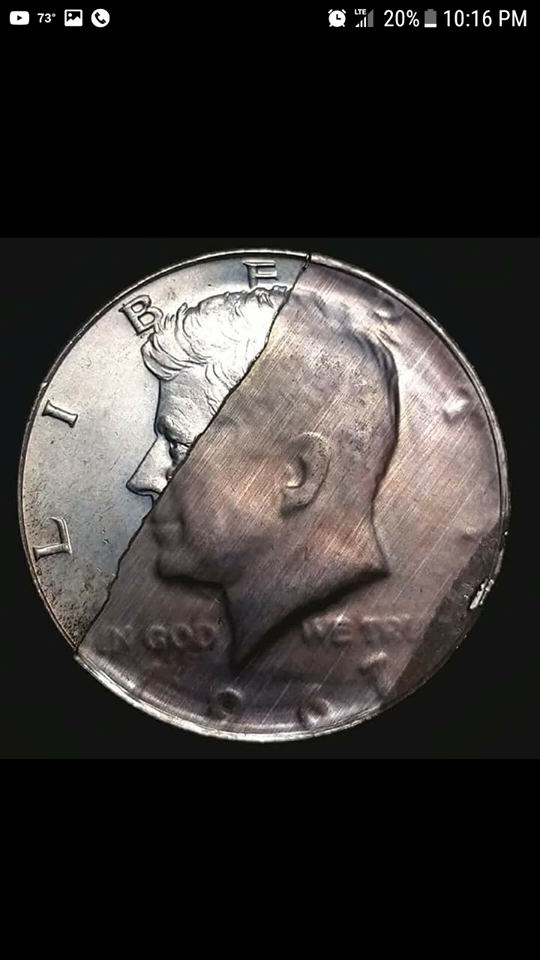
This beautiful specimen was submitted by Ray Chupp. This is a great example of a missing partial clad layer. 2 seperate pieces of the obverse clad layer delaminated from the coin. Luckily both pieces were saved and still with the owner of the coin.


Bibliography
ALTERNATIVE METALS STUDY Contract Number: TM-HQ-11-C-0049
FINAL REPORT August 31, 2012
Submitted to: United States Mint 801 Ninth Street, NW Washington, DC 20220
Submitted by: Concurrent Technologies Corporation
The elements of the periodic table sorted by density
https://www.lenntech.com/periodic-chartelements/density.htm#ixzz5Gthx5Xe1
Accessed 6/7/2018
Missing Clad Discussion:
http://www.error-ref.com/?s=missing+clad Accessed 6/7/2018
Coinage Strips
http://www.olinbrass.com/markets/coinage Accessed 6/7/2018
Coreless
http://www.error-ref.com/coreless_or_all_clad_cooins/ Accessed 6/7/2018
https://www.coinworld.com/news/us-coins/2011/12/varying-weightsundercut-solid-coreless-dime-.all.html
Accessed 6/7/2018
United States Patent Office 3,466,157 Patented Sept. 9, 1969
COMPOSITE METAL CONTAINING COPPER FOR CONAGE PURPOSES
Philip B. Neisser, Alexandria, Va., and Morris V. Boley, Bethesda, Md., assignors
to the United States of America as represented by the Department of the
Treasury Filed Oct. 22, 1965, Ser. No. 502,738 Int, C. B23p 3/20
U.S. C, 29-199 13 Claims Filed Oct. 22, 1965
https://patents.google.com/patent/US3466157A/en Accessed 6/7/2018
Wikipedia - Quarter (United States coin)
https://en.wikipedia.org/wiki/Quarter_(United_States_coin) Accessed 6.7.2018
Wikipedia - Presidential $1 Coin Program
https://en.wikipedia.org/wiki/Presidential_$1_Coin_Program Accessed
6.7.2018